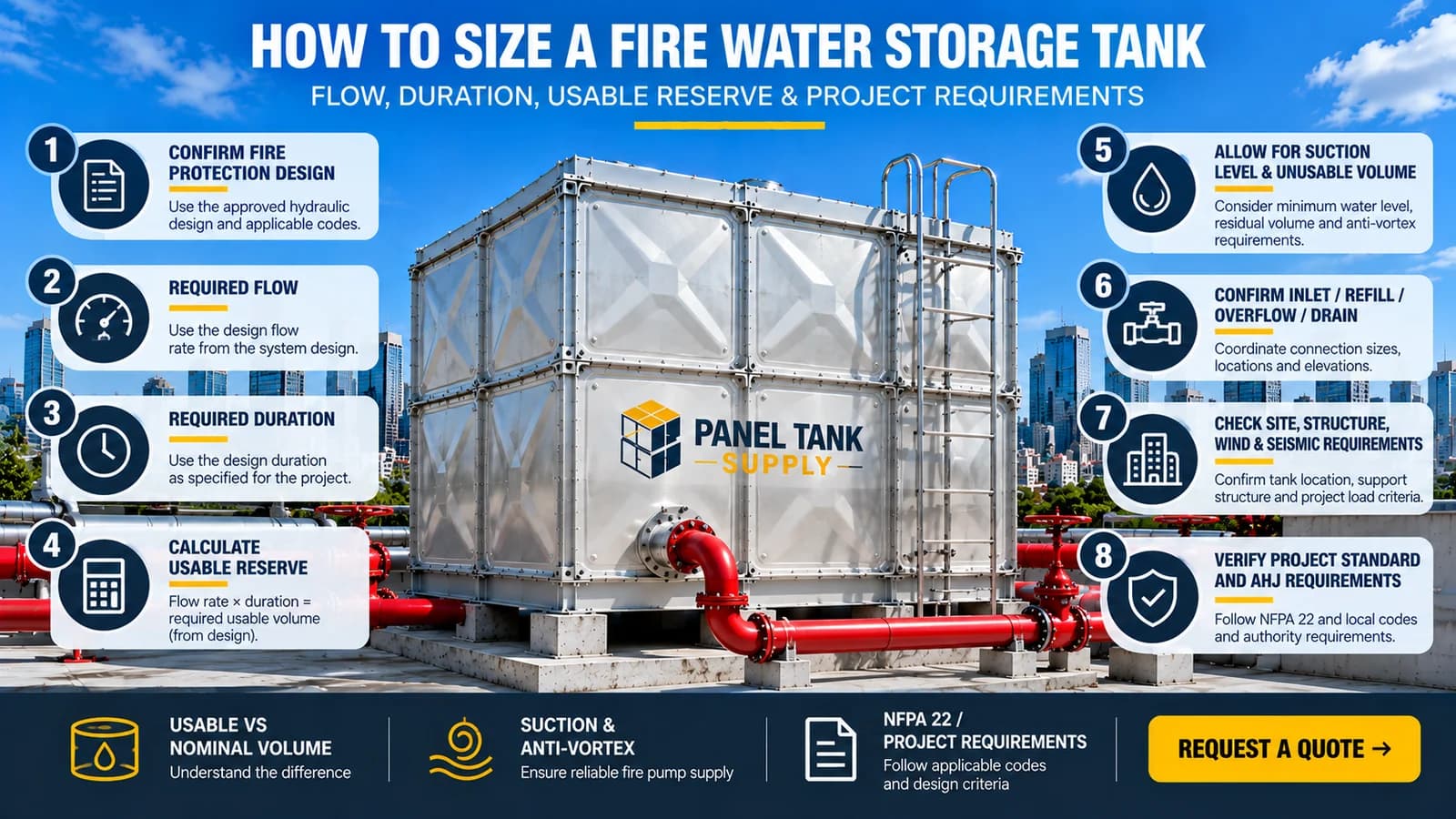
A fire water storage tank should be sized from the approved fire-protection design, not from a generic building size, an online rule of thumb or the amount of space available for a tank.
The required usable fire-water reserve normally comes from the hydraulic and fire-protection design, which establishes the system demand, required duration and other project-specific requirements.
Once that required usable volume is known, the tank can be configured around suction level, overflow, freeboard, residual volume, refill arrangement, available site dimensions, structural loads, connections and the applicable project standards.
For US projects, NFPA 22 is an important reference for water tanks used for private fire protection, but the project fire-protection engineer, specification and authority having jurisdiction should confirm which requirements apply to the actual installation.
This guide explains the main considerations involved in fire water tank sizing so engineers, contractors and buyers can coordinate the correct tank configuration before requesting a quotation.
Fire Water Tank Sizing Starts With the Approved Fire-Protection Design
The most important rule is simple:
Do not determine the required fire-water reserve from the tank itself.
The fire-protection design should first establish the water requirement that the tank needs to support.
Depending on the project, the fire system may include:
- Automatic sprinkler systems
- Standpipe or hose systems
- Fire pumps
- Hydrants
- Water-spray systems
- Other water-based fire-protection systems
The applicable fire-protection designer should determine the required demand, duration and system arrangement.
The tank supplier can then configure a tank to provide the required usable reserve.
1. Confirm the Required Fire-Protection Flow
The required flow should come from the approved fire-protection or hydraulic design.
It should not be guessed from:
- Building floor area alone
- Tank material
- Available plant-room dimensions
- A generic gallons-per-square-foot assumption
- A previous unrelated project
The fire-protection system design determines the flow that the stored water must support.
This design information should be confirmed before the tank capacity is finalized.
2. Confirm the Required Duration
Fire-water storage is also influenced by how long the required system demand must be available.
The applicable duration should come from the fire-protection design and project requirements.
For conceptual understanding, the required reserve is related to the approved design demand over the required operating duration.
However, the final usable volume should always be taken from the approved project design rather than calculated independently by the tank supplier or purchaser.
3. Required Usable Volume Is More Important Than Nominal Volume
A fire-water tank should provide the required usable reserve.
That is not necessarily the same as the tank’s total geometric or nominal capacity.
Some water may be unavailable to the fire-protection system because of:
- Minimum suction level
- Outlet elevation
- Anti-vortex arrangement
- Residual water below the effective suction level
- Freeboard
- Overflow elevation
- Internal tank geometry
For this reason, a requirement for a particular usable fire reserve does not automatically mean a tank with exactly the same nominal capacity will be sufficient.
4. Usable Capacity vs Nominal Capacity
| Term | Meaning |
|---|---|
| Nominal / geometric capacity | The overall water-holding volume represented by the tank geometry or stated tank size. |
| Maximum operating level | The normal upper water level established by the tank and overflow arrangement. |
| Minimum usable level | The lowest level from which the fire-protection system can reliably use stored water. |
| Residual / unusable volume | Water below the effective usable level that should not automatically be counted toward the required fire reserve. |
| Usable fire reserve | The water volume actually available to satisfy the approved fire-protection requirement. |
The approved project requirement should therefore specify or establish the required usable reserve rather than relying only on a headline tank capacity.
5. Confirm the Fire Pump Suction Arrangement
The suction arrangement can directly affect usable tank volume.
The tank configuration should be coordinated with the fire-protection designer and pump arrangement.
Relevant information can include:
- Suction connection size
- Suction connection elevation
- Fire pump arrangement
- Minimum effective operating level
- Anti-vortex requirements
- Connected pipe arrangement
The suction connection should not be treated as an ordinary outlet that can simply be positioned after the tank has already been selected.
6. Anti-Vortex Requirements
Fire-water suction arrangements may require measures intended to reduce vortex formation and maintain reliable water supply to the fire pump.
The exact arrangement should follow the fire-protection design and requirements applicable to the project.
Where an anti-vortex component is required, its geometry and position can affect the usable water level and connection details.
This is another reason the tank supplier should receive the fire-system requirements before manufacture.
7. Confirm the Overflow Level
The overflow helps define the maximum normal water level inside the tank.
The overflow arrangement should be coordinated with:
- Maximum operating water level
- Required freeboard
- Tank roof
- Fill arrangement
- Overflow pipe diameter
- Overflow discharge location
The overflow level is part of the usable-capacity calculation because water above the normal overflow level cannot be relied upon as stored reserve.
8. Confirm the Fill and Refill Arrangement
The project design should establish how the tank is filled and what refill requirements apply.
Relevant information may include:
- Available incoming water supply
- Fill connection size
- Fill location
- Control arrangement
- Required refill performance
- Project-specific fire-protection requirements
The presence of a refill supply should not be used to reduce required stored volume unless the approved fire-protection design specifically allows that approach.
9. Do Not Size a Fire Tank From Building Area Alone
Building size may influence the overall fire-protection design, but it is not a substitute for a hydraulic calculation or approved system requirement.
Two buildings of similar floor area can have different:
- Occupancies
- Fire hazards
- Sprinkler designs
- Standpipe arrangements
- System demands
- Required durations
- Local approval requirements
The fire-water tank should therefore follow the actual project fire design.
10. NFPA 22 and Project Requirements
NFPA 22 is an important US standard relating to water tanks for private fire protection.
However, specifying “NFPA 22 tank” does not by itself define every project requirement.
The complete installation can also require coordination of:
- Required usable capacity
- Tank type
- Structural design
- Suction arrangement
- Fill arrangement
- Overflow
- Drain
- Heating where required
- Access
- Level indication
- Foundation
- Project-specific accessories
The project specification and authority having jurisdiction should be reviewed before manufacture.
We will cover this in more detail in the dedicated guide NFPA 22 Water Tanks: What to Confirm Before Ordering.
11. Local AHJ Requirements Matter
The authority having jurisdiction may impose or interpret requirements that affect the fire-water system.
Those requirements should be resolved early where they influence:
- Tank capacity
- Connections
- Fire pump arrangement
- Structural requirements
- Access
- Heating
- Inspection
- Testing
- Project documentation
It is much easier to resolve these requirements before tank manufacture than after a tank has been delivered.
12. Fit the Tank to the Available Site
Once the required usable reserve is established, the tank configuration can be developed around the available space.
Provide:
- Maximum available length
- Maximum available width
- Maximum available height
- Indoor or outdoor installation
- Existing walls and columns
- Pipework
- Access routes
- Required maintenance clearance
The required fire-water capacity should not be reduced simply because the initially proposed tank room is too small.
Instead, the project team may need to review the tank proportions, tank location or overall plant arrangement.
13. Rectangular vs Circular Fire Water Tanks
Different modular tank systems can suit different fire-water projects.
Rectangular Sectional Tanks
Rectangular sectional systems can use available building floor area efficiently and may be useful in plant rooms or constrained commercial sites.
Materials can include:
Large Bolted Tanks
For larger external fire-water reserves, bolted systems such as glass fused to steel tanks may also be considered depending on the project specification, capacity and site arrangement.
The tank technology should follow the application and project requirements rather than being selected before the fire reserve is known.
14. Fire Tank Material Selection
Fire-water capacity and tank material are separate decisions.
The required fire reserve should first be established by the fire-protection design.
Then the tank material can be reviewed against:
- Required capacity
- Available footprint
- Indoor or outdoor installation
- Corrosion environment
- Water quality
- Restricted access
- Project design life
- Maintenance expectations
- Project specifications
There is no single tank material that is automatically correct for every fire-water project.
15. Restricted-Access Fire Water Tanks
Commercial buildings sometimes require significant fire-water storage inside plant rooms, basements or other locations where a complete fabricated tank cannot be delivered.
A sectional tank can help because individual panels are transported into the space and assembled at the final tank location.
Before selecting the configuration, check:
- Door dimensions
- Corridor width
- Elevator dimensions and capacity
- Stair access
- Available assembly clearance
- Working space around the tank
See What Is a Sectional Water Tank?
16. Confirm the Foundation and Structural Design
A full fire-water tank can impose substantial loads on its supporting structure.
The structural design should consider the actual tank arrangement and project location.
Depending on the installation, inputs may include:
- Tank operating weight
- Hydrostatic load
- Wind
- Seismic requirements
- Roof loading
- Anchorage
- Foundation reactions
- Connected pipe loads
The project structural engineer and tank supplier should coordinate the foundation interface for the selected tank.
17. Wind and Seismic Requirements Are Site Specific
Do not assume that one wind or seismic design applies to an entire state.
The relevant structural criteria should be established for the actual project location and tank arrangement.
This is particularly important for exposed outdoor tanks and projects in higher wind or seismic regions.
18. Cold-Weather Projects
Projects in freezing climates may require additional consideration of:
- Water temperature
- Tank heating where required
- Insulation
- Exposed pipework
- Roof conditions
- Maintenance access
The applicable fire-protection design and project specification should establish any cold-weather requirements.
19. Coordinate the Drain
The tank drain supports emptying, maintenance and inspection.
Confirm:
- Drain size
- Location
- Connection type
- Discharge arrangement
- Site drainage capability
The drain should be coordinated with the surrounding site rather than terminating without a suitable discharge plan.
20. Level Indication and Monitoring
Fire-water storage projects may require level indication or monitoring arrangements.
The tank supplier should know what equipment or penetrations need to be incorporated into the tank package.
Confirm any required:
- Level indication
- Low-level signals
- High-level signals
- Instrumentation connections
- Control interfaces
The exact system requirements should come from the fire-protection and controls design.
21. Tank Capacity Should Be Confirmed Before Manufacturing
Late capacity changes can affect almost every part of a tank project.
A change in required usable reserve can affect:
- Tank dimensions
- Panel count
- Tank height
- Foundation loads
- Roof arrangement
- Connection positions
- Freight
- Cost
The fire-protection design should therefore be sufficiently developed before the final tank is released for manufacture.
22. Information to Send the Tank Supplier
For an accurate fire-water tank quotation, provide as much of the following information as possible:
- Required usable fire-water reserve
- Approved fire-system design information
- Project ZIP code and state
- Maximum available tank dimensions
- Indoor or outdoor location
- Preferred tank material if specified
- Fire suction size and location
- Fill connection size and location
- Overflow size and location
- Drain size and location
- Operating and suction levels where known
- Access requirements
- Level indication requirements
- Required ladders or platforms
- Structural design criteria
- Applicable standards
- AHJ requirements
- Project specifications
- Drawings
- Required delivery date
23. Common Fire Water Tank Sizing Mistakes
Choosing the Tank Before the Fire Design Is Complete
The required reserve should drive the tank configuration, not the other way around.
Using Nominal Capacity as Usable Reserve
Check suction levels, residual water, overflow and freeboard before confirming usable volume.
Guessing the Required Duration
Use the duration established by the approved project design.
Ignoring the Suction Arrangement
Fire pump suction details can affect usable water level and connection design.
Forgetting Local Approval Requirements
Resolve AHJ and project-specific requirements before manufacture.
Ignoring Structural Loads
The foundation and supporting structure need to suit the actual filled tank and project design criteria.
How to Size a Fire Water Storage Tank: Final Answer
A fire-water tank should be sized from the approved fire-protection requirement.
The design should establish the required demand, duration and usable reserve. The tank supplier can then configure a tank that provides that usable water volume while accounting for suction level, residual volume, overflow, freeboard, connections and project constraints.
Do not select the tank from building area or nominal tank capacity alone.
For US projects, confirm the applicable NFPA 22, project specification, structural requirements and authority-having-jurisdiction requirements before manufacture.
Once those requirements are established, the tank material, dimensions and modular configuration can be selected around the actual fire-protection project.
Need a Fire Water Tank Sized for Your Project?
Panel Tank Supply can review the approved fire-water requirement and site constraints and help identify a suitable modular tank configuration for quotation.
Send the required usable reserve, project ZIP code and state, available dimensions, suction and fill requirements, overflow and drain sizes, structural criteria and any available fire-protection drawings or specifications.
Request Fire Water Tank Pricing →
Frequently Asked Questions
How Do You Size a Fire Water Storage Tank?
The required usable capacity should come from the approved fire-protection or hydraulic design. The tank is then configured around that reserve while accounting for suction level, residual volume, overflow, freeboard and site requirements.
Can I Calculate Fire Tank Size From Building Area?
Building area alone is not sufficient. The applicable fire-protection design should establish the system demand, required duration and usable water reserve.
What Is the Difference Between Nominal and Usable Fire Tank Volume?
Nominal volume describes overall tank capacity, while usable fire reserve is the water volume actually available to the fire-protection system after accounting for suction level, residual volume, overflow and other operating limits.
Does the Fire Pump Suction Level Affect Tank Size?
Yes. Water below the effective usable suction level should not automatically be counted toward the required usable fire reserve.
What Is NFPA 22?
NFPA 22 is the US standard for water tanks used for private fire protection. The applicable project requirements and edition should be confirmed with the fire-protection designer, project specification and authority having jurisdiction.
Can GRP Tanks Be Used for Fire Water?
GRP / FRP sectional tanks may be considered for fire-water storage where the selected system meets the project’s capacity, structural, material and fire-protection requirements.
Can Galvanized Steel Tanks Be Used for Fire Water?
Galvanized sectional steel tanks are commonly considered for fire-water storage where the system is suitable for the required capacity, site conditions and project specification.
Can Glass Fused to Steel Tanks Be Used for Fire Water?
Large bolted glass fused to steel tanks may also be considered for fire-water projects, particularly where substantial external storage capacity is required and the project specification supports that system.
What Information Is Needed for a Fire Tank Quote?
Provide the approved usable reserve, project location, available dimensions, suction and fill requirements, overflow, drain, tank material requirements, structural criteria, project specifications and applicable fire-protection documentation.