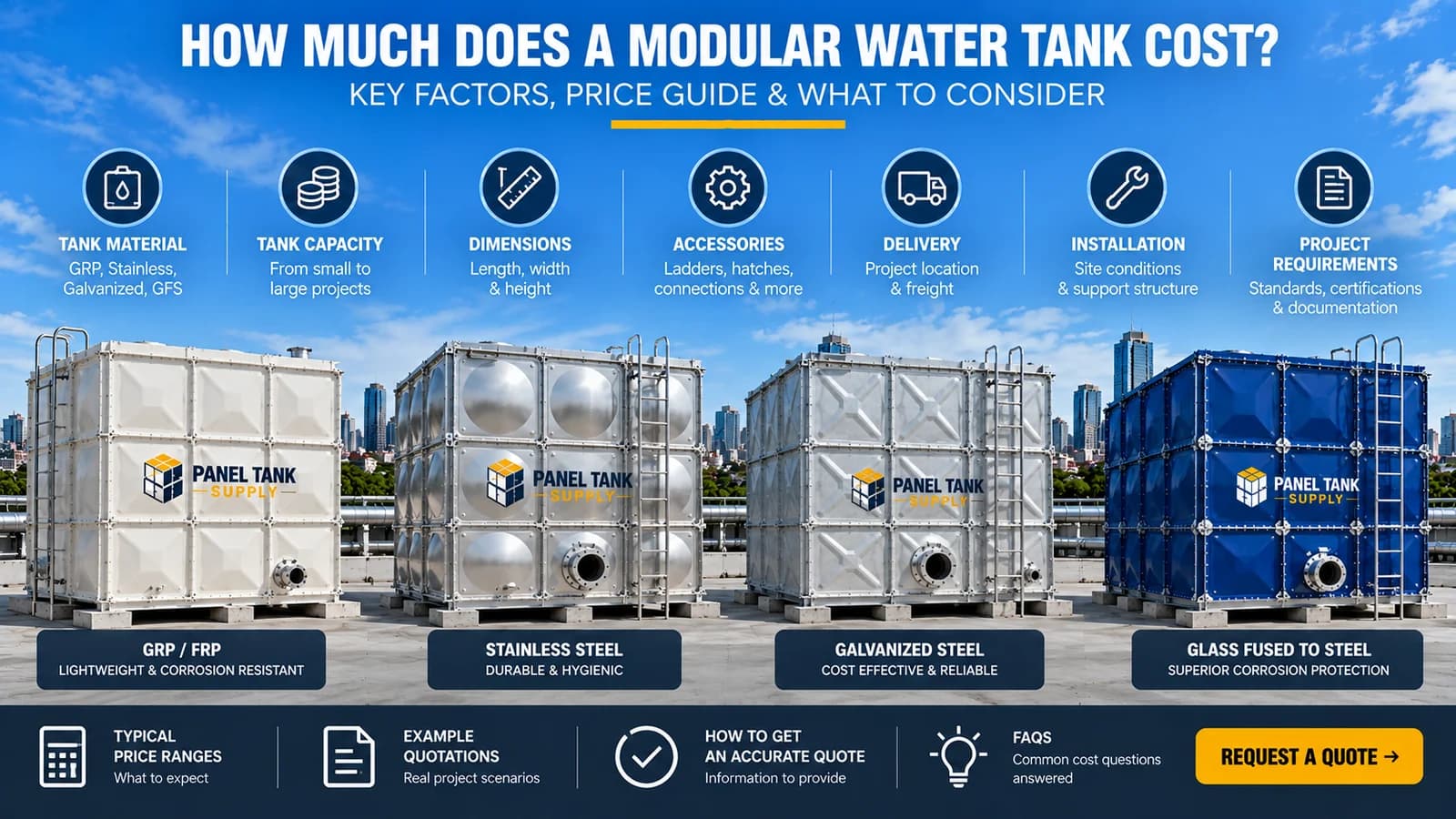
There is no reliable single price for every modular water tank.
The cost of a panel water tank depends on much more than storage capacity. Material, tank dimensions, height, structural requirements, roof design, connections, accessories, project location, freight and documentation can all change the final supply price.
This is why two tanks with the same nominal capacity can have noticeably different quotations.
A low, wide tank may require a different structural arrangement from a tall, narrow tank. A simple clean-water tank can also have a very different scope from a project requiring large nozzles, special coatings, access platforms, certification or higher wind and seismic design loads.
This guide explains the main factors that affect modular water tank cost and the information buyers should provide to receive a useful project-specific quotation.
Can You Price a Modular Tank by the Gallon?
Price-per-gallon figures can be useful as a very rough comparison tool, but they are not a reliable way to define the actual cost of an engineered modular tank.
Two tanks can hold the same volume while having completely different:
- Materials
- Lengths
- Widths
- Heights
- Panel arrangements
- Structural reinforcement
- Roof systems
- Connections
- Accessories
- Engineering requirements
- Freight costs
For this reason, project pricing should be based on an actual tank configuration rather than capacity alone.
Main Factors That Affect Modular Water Tank Cost
| Cost Factor | Why It Matters |
|---|---|
| Tank material | GRP / FRP, stainless steel, galvanized steel and GFS use different materials and manufacturing systems. |
| Capacity | Larger storage generally requires more panels, structure and components. |
| Tank dimensions | Length, width, diameter and height influence the complete structural configuration. |
| Tank height | Greater water depth increases hydrostatic loading and can change structural requirements. |
| Structural design | Bracing, panel thickness and supports depend on the selected system and design loads. |
| Roof system | Roof type, access hatches, vents and project loads can change the supply scope. |
| Connections | Quantity, size, position and type of nozzles or fittings affect manufacturing. |
| Accessories | Ladders, platforms, level indicators, insulation and other options add scope. |
| Coating or grade | Material grades and specialist coating requirements can affect price. |
| Engineering | Wind, seismic, structural and project-specific criteria can change the tank design. |
| Documentation | Drawings, certifications, testing or project submittals may form part of the scope. |
| Freight | Project ZIP code, package size, weight and delivery requirements affect transport cost. |
1. Tank Material
Material selection is one of the first major cost variables.
Panel Tank Supply works with several modular tank systems, including:
- GRP / FRP panel tanks
- Stainless steel panel tanks
- Galvanized steel panel tanks
- Glass fused to steel bolted tanks
These materials should not be compared only by initial panel price.
The correct material depends on factors such as:
- Stored water or process liquid
- Corrosion exposure
- Water chemistry
- Potable-water requirements
- External environment
- Required capacity
- Maintenance expectations
- Project specifications
The lowest-cost material is not necessarily the lowest-cost solution if it is poorly matched to the project.
2. Tank Capacity
Capacity clearly affects price because a larger tank generally requires more material and more structural components.
However, cost does not increase in a perfectly linear relationship with gallons stored.
A larger tank may sometimes use its footprint and structural arrangement more efficiently than a smaller but unusually shaped tank.
Capacity should therefore be evaluated together with tank dimensions.
3. Tank Height Can Have a Major Impact
Tank height matters because water creates hydrostatic pressure.
As the water depth increases, the structural demands on lower panels and supporting components can also increase.
A tall tank may therefore require a different panel thickness, reinforcement arrangement or structural configuration from a shallower tank of similar capacity.
This is one reason two equal-volume tanks can have different prices.
4. Footprint and Geometry
The available site space can strongly influence the tank configuration.
Consider two projects requiring approximately the same storage volume.
Project A may have a large floor area and allow a relatively low tank.
Project B may have a restricted footprint and require a much taller tank.
The required usable capacity may be similar, but the structural design can be different.
When requesting a quote, provide:
- Maximum available length
- Maximum available width
- Maximum available height
- Any fixed obstacles
- Required assembly clearance
If dimensions are not yet fixed, provide the available site envelope so alternative configurations can be considered.
5. GRP / FRP Tank Cost Factors
GRP / FRP sectional tanks use molded fiberglass-reinforced panels assembled into a modular rectangular system.
Cost can be influenced by:
- Panel configuration
- Tank height
- Structural reinforcement
- Resin and product specification
- Roof arrangement
- Connections
- Access components
- Potable-water requirements where applicable
- Freight
GRP / FRP may be attractive where lightweight components, restricted access and resistance to conventional steel rust are important considerations.
6. Stainless Steel Tank Cost Factors
Stainless steel tank pricing depends partly on the stainless grade and quantity of material required.
Common project considerations include:
- 304 versus 316-family material
- Water chemistry
- Chloride exposure
- Tank dimensions
- Panel thickness
- Reinforcement
- Connections
- Access components
- Surface-treatment requirements
316-family stainless generally carries a higher material cost than 304, but the more important question is which grade is appropriate for the actual water service and environment.
See 304 vs 316 stainless steel water tanks.
7. Galvanized Steel Tank Cost Factors
Galvanized sectional tanks use pressed steel panels with galvanized corrosion protection.
Pricing can be affected by:
- Tank capacity
- Panel thickness
- Height
- Structural reinforcement
- Support requirements
- Roof system
- Connection sizes
- Accessories
- Environmental requirements
- Freight
Galvanized systems are commonly considered for fire-water, building-services and general industrial water duties when the selected system is suitable for the project.
8. Glass Fused to Steel Tank Cost Factors
Glass fused to steel tanks are commonly engineered as larger bolted steel systems.
The quotation can depend on:
- Required capacity
- Tank diameter
- Tank height
- Stored medium
- Coating system
- Design loads
- Roof arrangement
- Ladders and platforms
- Mixers or specialist equipment
- Pipe penetrations
- Testing and certification requirements
- Freight
For process or wastewater applications, the stored medium, pH, temperature and chemical exposure can also affect the coating specification.
9. Connections Can Change the Price
Connections are sometimes treated as a minor detail during early budgeting, but they can materially affect a final tank quotation.
A tank may require:
- Inlet
- Outlet
- Overflow
- Drain
- Fire suction connection
- Return connection
- Level instrumentation
- Special process nozzles
The quantity, diameter, location and connection type should be established as early as possible.
A tank requiring several large specialist nozzles will generally have a different manufacturing scope from the same tank with only basic connections.
10. Accessories Add to the Supply Scope
Tank accessories can include:
- Access hatches
- Internal ladders
- External ladders
- Platforms
- Handrails
- Vents
- Level indicators
- Insulation
- Roof penetrations
- Special fittings
These should be included in the project brief so suppliers are pricing the same scope.
11. Wind and Seismic Design Can Affect Cost
Structural requirements are site specific.
A tank designed for one location should not automatically be assumed suitable for another location.
Depending on the project, the tank design may need to consider:
- Hydrostatic loads
- Wind loads
- Seismic criteria
- Roof loads
- Platform loads
- Pipe loads
- Foundation interface
- Anchorage
Higher or more demanding design criteria can change the structural components included in the tank package.
12. Project Standards and Certification
Documentation requirements should be identified during quotation rather than after an order is placed.
Depending on the project, the supply package may need:
- Technical data
- General arrangement drawings
- Material information
- Product certifications
- Engineering documentation
- Testing records
- Specific client submittals
Only certifications applicable to the exact proposed system should be claimed or relied upon.
13. Freight and Project Location
Modular tanks have an important logistics advantage because they can be shipped as panels and components rather than as one completed oversized vessel.
However, freight still affects project cost.
Transportation can depend on:
- Project ZIP code
- Distance from supply point
- Package quantity
- Package dimensions
- Package weight
- Delivery restrictions
- Unloading requirements
- Remote-site logistics
This is why the project ZIP code should be included in an early budget enquiry.
14. Restricted Access Can Affect the Project Scope
Modular tanks are particularly useful where access is constrained, but the actual access route still needs to be understood.
Relevant information may include:
- Door dimensions
- Corridor width
- Elevator dimensions and capacity
- Stair or rooftop access
- Crane restrictions
- Available assembly space
- Working clearance around the tank
If standard panel dimensions cannot practically reach the installation location, the available tank options may change.
See what is a sectional water tank?
15. Does Installation Affect the Tank Price?
When comparing quotations, make sure you understand exactly what each supplier has included.
A tank supply package and a fully installed tank project are not necessarily the same scope.
Check whether the quotation includes or excludes items such as:
- Tank supply
- Freight
- Site unloading
- Tank assembly
- Foundation works
- Crane or lifting equipment
- Connected pipework
- Electrical work
- Commissioning
Comparing two headline prices without aligning the scope can produce a misleading result.
16. Why Two Equal-Capacity Tanks Can Cost Different Amounts
Consider two hypothetical tanks that provide the same required storage volume.
Tank A
- Low, wide configuration
- Standard connections
- Simple roof
- Moderate design loads
- Easy delivery access
Tank B
- Tall, narrow configuration
- Large specialist nozzles
- Access platform
- Higher structural design loads
- Restricted urban delivery
Although both tanks may store the same amount of water, their structural and supply requirements are different.
This is why capacity alone is not enough to establish an accurate price.
17. Budget Price vs Project Quote
There is also a difference between an early budget and a developed project quotation.
Early Budget
An early budget may be based on preliminary information such as:
- Approximate capacity
- Preferred material
- Approximate dimensions
- Application
- Project ZIP code
Developed Quote
A more detailed quotation can incorporate:
- Confirmed dimensions
- Connection schedule
- Design criteria
- Accessories
- Drawings
- Specifications
- Required certifications
- Delivery requirements
The more complete the project information, the more accurately the tank package can be defined.
18. How to Get a More Accurate Modular Water Tank Quote
For useful pricing, provide as much of the following as possible:
- Required storage capacity
- Usable or operating volume where relevant
- Water or liquid being stored
- Preferred tank material if known
- Available length
- Available width
- Maximum height
- Project ZIP code and state
- Indoor or outdoor location
- Site-access restrictions
- Inlet size and location
- Outlet size and location
- Overflow size and location
- Drain requirements
- Required accessories
- Project standards
- Certification requirements
- Drawings or specifications
- Required delivery date
If some information is still unknown, provide what is available and identify the items that are still being developed.
19. Should You Choose the Cheapest Tank?
Initial supply price is important, but it should not be the only selection criterion.
A lower-cost option may not represent better value if it does not suit:
- The stored water
- The site environment
- The required design loads
- The access conditions
- The required service life
- The project specification
- The maintenance strategy
Compare complete project-compliant tank packages rather than simply selecting the lowest headline price.
20. How Much Does a Modular Water Tank Cost? Final Answer
There is no reliable universal cost for a modular water tank because each project can require a different combination of material, capacity, dimensions, structure, roof, connections, accessories, engineering, documentation and freight.
A price-per-gallon figure cannot capture all of those variables.
The most useful approach is to provide the required capacity, site dimensions, application, water service, project location, connections and specifications so an actual tank configuration can be priced.
This provides a much more meaningful budget than trying to apply one generic price to every modular tank project.
Need Project-Specific Modular Water Tank Pricing?
Panel Tank Supply can review your project requirements and prepare pricing around an appropriate modular tank configuration.
Send the required capacity, application, project ZIP code and state, available dimensions, preferred material if known, connection requirements, required delivery date and any drawings or specifications.
Frequently Asked Questions
How Much Does a Modular Water Tank Cost?
There is no single reliable price because cost depends on the material, capacity, dimensions, structural requirements, connections, accessories, project location, documentation and freight.
Can You Price a Panel Water Tank Per Gallon?
Price per gallon can be misleading because two equal-capacity tanks can have very different geometry, structure, materials and accessories. Project-specific pricing is more useful.
What Is the Biggest Factor Affecting Water Tank Price?
There is no single factor. Material, capacity, tank height, footprint, structural design, connections and project requirements all work together to determine the final package.
Does a Taller Tank Cost More?
Tank height can influence price because increased water depth changes hydrostatic loading and can affect panel thickness, reinforcement and structural configuration.
Does Stainless Steel Cost More Than GRP?
Material costs differ, but a meaningful comparison requires complete project-specific tank packages. Grade, tank geometry, structure, connections and other requirements can change the relative price.
Does Freight Affect Modular Tank Pricing?
Yes. Freight depends on the project location, tank package, shipment size, weight and delivery requirements. Providing the project ZIP code helps develop a more realistic budget.
Can I Get a Budget Price Before Final Drawings Are Ready?
Often, an early budget can be developed from preliminary capacity, dimensions, application, material preference and project location. Pricing can then be refined as the project details develop.
What Do I Need to Send for an Accurate Quote?
Provide capacity, application, project location, available dimensions, water service, connections, required accessories, design requirements, delivery date and any available drawings or specifications.