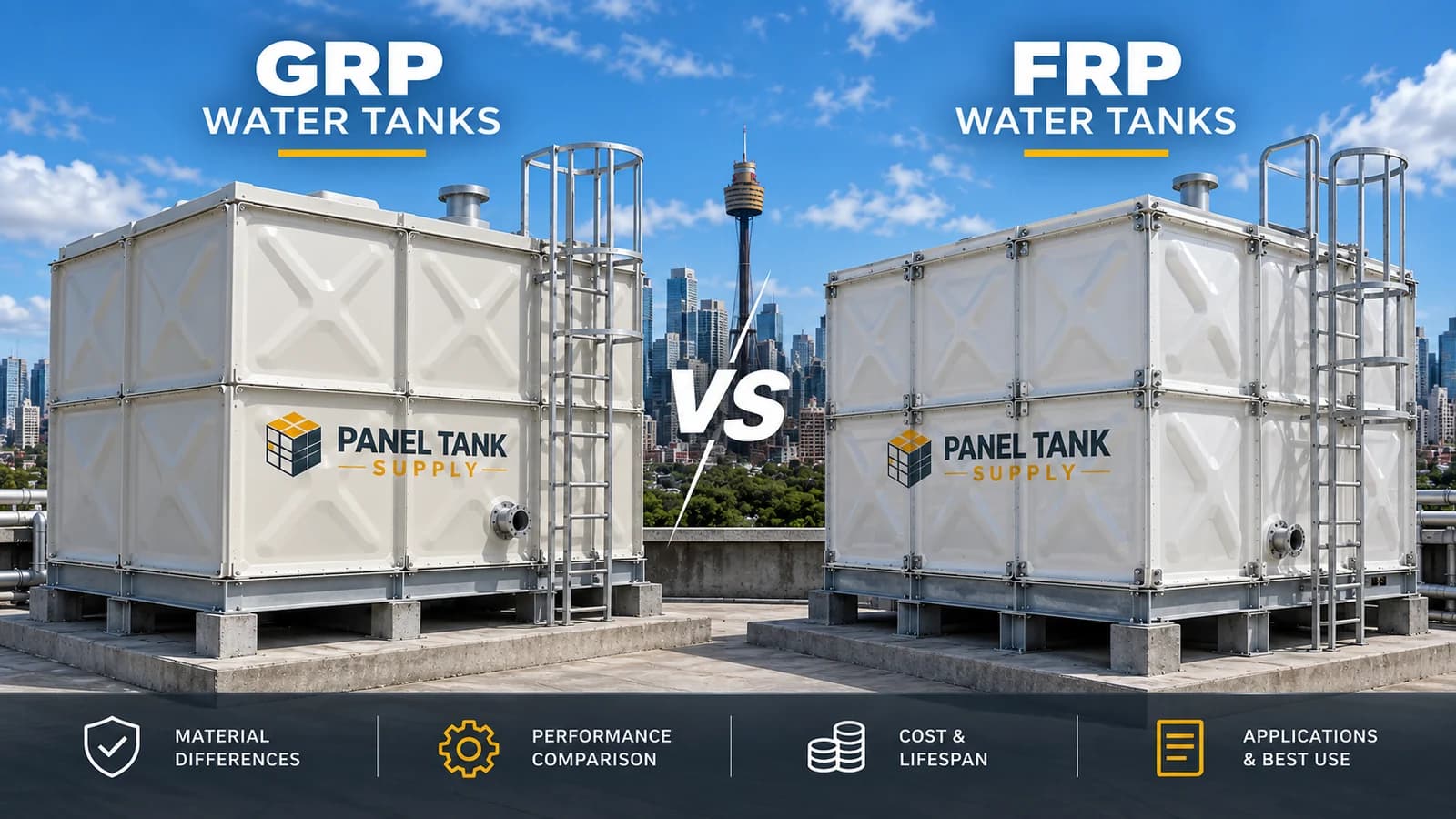
If you are comparing GRP vs FRP water tanks, the first thing to understand is that you may not actually be comparing two completely different tank materials.
GRP means Glass Reinforced Plastic, while FRP means Fiber Reinforced Plastic. When the reinforcing fiber used in an FRP material is glass fiber, the same composite can reasonably be described as both GRP and FRP.
In the United States, terms such as FRP water tank and fiberglass water tank are particularly common. GRP is also widely used internationally and within the modular panel tank industry.
For buyers, engineers and contractors, the important question is therefore not simply whether a supplier calls a tank GRP or FRP. What matters more is the actual panel construction, reinforcement, resin system, sealing arrangement, structural design, intended water service and applicable certification.
This guide explains GRP vs FRP terminology and the technical information that should be reviewed when selecting a GRP / FRP modular panel water tank.
What Does GRP Mean?
GRP stands for Glass Reinforced Plastic.
It describes a composite material in which glass fibers reinforce a polymer or resin-based matrix.
The reinforcing fibers help provide strength and stiffness, while the resin system binds the reinforcement together and forms the composite panel.
In modular water storage applications, GRP panels can be manufactured as molded sectional components and mechanically assembled to create tanks in a range of capacities and dimensions.
This sectional construction can be particularly useful where a complete one-piece tank would be difficult to transport or install.
What Does FRP Mean?
FRP stands for Fiber Reinforced Plastic, sometimes also described as fiber-reinforced polymer depending on the industry and technical context.
FRP is a broader term because the reinforcing fiber does not necessarily have to be glass.
Different composite materials can theoretically use different reinforcing fibers.
However, when the reinforcement used in the tank panels is fiberglass, the terms FRP, fiberglass and GRP may all be used when discussing the same general family of tank construction.
So, Is There Actually a Difference Between GRP and FRP Water Tanks?
In many water-tank enquiries, the difference is mainly terminology rather than a completely different tank technology.
A fiberglass-reinforced panel can fit within the broader definition of FRP while also being specifically described as GRP because the reinforcing fiber is glass.
That means a buyer searching for:
- GRP water tanks
- FRP water tanks
- Fiberglass water tanks
- GRP sectional tanks
- FRP panel tanks
- Fiberglass panel water tanks
may be researching substantially the same type of modular composite water-storage system.
However, two tanks should never be assumed to be technically identical simply because both suppliers use the term GRP or FRP.
The actual product specification still needs to be compared.
GRP vs FRP Water Tanks: Quick Comparison
| Consideration | GRP | FRP |
|---|---|---|
| Full term | Glass Reinforced Plastic | Fiber Reinforced Plastic |
| Meaning | Specifically identifies glass as the reinforcement | Broader composite-material term |
| Common US terminology | Used, particularly in technical and international specifications | Very commonly used alongside fiberglass |
| Can it use glass fiber? | Yes, by definition | Yes |
| Water-tank context | Often describes molded fiberglass composite panels | Often describes the same fiberglass composite tank family |
| Does the acronym define the complete specification? | No | No |
| Important technical factors | Resin, panel design, reinforcement, seals, structure and certification | Resin, panel design, reinforcement, seals, structure and certification |
The key takeaway is simple: the product specification matters more than the acronym.
1. Why Are Both Terms Used?
Different countries, industries, manufacturers and engineering specifications have historically adopted different terminology.
GRP explicitly tells the reader that glass is the reinforcing fiber.
FRP describes the broader category of fiber-reinforced plastics.
In the United States, fiberglass and FRP are familiar commercial terms, while GRP is commonly encountered in international water-storage specifications and sectional tank documentation.
This creates situations where one project document may say GRP while a contractor, consultant or supplier refers to essentially the same construction as FRP or fiberglass.
2. Does GRP Mean a Better Tank Than FRP?
No.
The terminology alone does not tell you which tank is higher quality.
Two products both described as GRP could still differ significantly in:
- Panel construction
- Panel thickness
- Reinforcement
- Resin formulation
- Manufacturing process
- Structural bracing
- Fasteners
- Seals and gaskets
- Roof construction
- Floor arrangement
- Connection details
- Accessories
- Certification
- Design loads
The same is true for products marketed as FRP.
A meaningful tank comparison therefore requires technical data for the exact system being proposed.
3. What Matters More Than GRP vs FRP Terminology?
When purchasing a modular fiberglass water tank, several factors are more important than which acronym appears on the brochure.
Stored Water or Liquid
First establish what the tank will store.
The requirements for potable water, fire water, HVAC make-up water, industrial water, rainwater or process water may differ.
Water chemistry, operating temperature and compatibility should be reviewed where relevant.
Required Capacity
Confirm the usable water-storage requirement rather than selecting a tank based only on approximate nominal volume.
The required capacity affects the tank footprint, height, panel configuration and structural arrangement.
Available Tank Dimensions
Provide the maximum available length, width and height.
Modular panel construction can be configured around many building and plant-room constraints, but there still needs to be sufficient space for assembly, connections and future maintenance.
Structural Design
Panel thickness, internal or external reinforcement and supporting arrangements are selected according to factors including tank height, geometry and applicable design loads.
Connections and Accessories
The complete tank may require:
- Inlets
- Outlets
- Overflows
- Drains
- Access hatches
- Ladders
- Vents
- Level indication
- Specialist nozzles
- Vortex-control components where required
These details should be coordinated before manufacture rather than added late in the project.
4. Are GRP and FRP Tanks Corrosion Resistant?
Fiberglass-reinforced composite panels do not undergo the conventional rusting mechanism associated with unprotected carbon steel.
This is one reason GRP / FRP systems can be attractive for water-storage projects where corrosion is an important material-selection consideration.
However, corrosion resistance should not be interpreted as universal chemical compatibility.
The actual resin system and complete tank construction still need to be appropriate for the stored medium, temperature and operating environment.
For projects comparing composite systems with metallic alternatives, see our guide to GRP vs galvanized steel water tanks.
5. Are GRP / FRP Tanks Lightweight?
One practical advantage of sectional composite tanks is the relatively low mass of individual components.
Compared with many metallic tank components, fiberglass panels can simplify handling and movement through constrained sites.
This becomes particularly valuable when tanks must be installed inside existing buildings, basements, rooftops or mechanical plant rooms.
Instead of trying to move one complete tank into position, the system can arrive as individual panels and components for assembly at the final location.
6. Are GRP / FRP Tanks Suitable for Restricted Access?
Restricted access is one of the strongest use cases for modular GRP / FRP panel tanks.
Panelized construction means individual components can potentially be transported through:
- Building doors
- Service corridors
- Loading areas
- Plant-room access routes
- Elevators where component size and loading permit
- Rooftop access arrangements
The tank can then be assembled inside the available installation area.
See our information on commercial building water storage tanks for projects where building access and tank footprint are important.
7. Can GRP / FRP Tanks Be Used for Potable Water?
GRP / FRP systems may be supplied for potable-water applications when the specific tank system and wetted materials are suitable for the intended service and meet the project’s required approvals.
The acronym GRP or FRP by itself does not prove potable-water compliance.
Buyers should verify documentation for the exact proposed product, including relevant requirements for panels, seals, gaskets, fasteners, fittings and other wetted components.
Learn more about potable water storage tanks.
8. Can GRP / FRP Tanks Be Used for Fire Water?
GRP / FRP sectional tanks can also be considered for fire-water storage where the proposed system matches the fire-protection design and project requirements.
Important information includes required usable volume, tank dimensions, suction arrangement, inlet and refill requirements, overflow, drain, access and applicable project documentation.
The required fire-water volume should come from the fire-protection design rather than being estimated from tank material.
See our fire water storage tank guidance.
9. Does FRP Always Mean Fiberglass?
Technically, not necessarily.
FRP is the broader term Fiber Reinforced Plastic. The reinforcing fiber could vary depending on the composite system.
GRP is more specific because the name explicitly identifies glass reinforcement.
In the commercial water-tank market, however, FRP is commonly used in connection with fiberglass-reinforced systems.
This is why the underlying technical specification should always be reviewed rather than assuming material composition from an acronym alone.
10. Which Term Should US Buyers Use?
For general searching in the United States, it can be useful to recognize all three terms:
- FRP water tank
- Fiberglass water tank
- GRP water tank
When issuing a formal project specification or purchase enquiry, however, clarity matters more than choosing one preferred acronym.
Describe the required service and request technical information for the actual proposed tank system.
For example, instead of requesting only “an FRP tank,” provide the capacity, water service, project location, available dimensions, connection requirements, access limitations and required certification.
11. GRP / FRP Tank Cost
There is no separate universal “GRP price” and “FRP price” simply because the terminology differs.
If both descriptions refer to comparable fiberglass sectional systems, price differences will come from the actual product and project specification.
Important cost factors include:
- Required capacity
- Tank dimensions
- Panel configuration
- Panel and resin specification
- Structural reinforcement
- Roof construction
- Connections
- Accessories
- Certification requirements
- Freight destination
- Project documentation
- Delivery schedule
For that reason, quotations should be compared on the same technical scope rather than by acronym or headline tank price alone.
12. What Should You Ask a GRP / FRP Tank Supplier?
Before placing an order, confirm the following:
- What exactly are the tank panels made from?
- What water or liquid is the system intended to store?
- What resin and panel specification applies?
- What structural reinforcement is included?
- What tank dimensions and usable capacity are proposed?
- What seals and fasteners are supplied?
- What roof and access arrangement is included?
- What connections are included?
- What certifications apply to the exact proposed system?
- What foundation or support information is required?
- What installation documentation is supplied?
- What inspection and maintenance requirements apply?
These questions tell you considerably more about the proposed tank than whether the brochure says GRP or FRP.
GRP vs FRP Water Tanks: Final Answer
For most modular fiberglass water-tank enquiries, GRP and FRP are not competing tank technologies.
GRP means Glass Reinforced Plastic. FRP means Fiber Reinforced Plastic. When the reinforcing fiber is glass, the material can fall within both descriptions and may also simply be called fiberglass.
The terminology varies between markets and suppliers, but the purchasing decision should focus on the actual tank system.
Compare the panel specification, resin, reinforcement, water compatibility, structure, sealing system, accessories, required certifications, installation conditions and whole project scope.
That is much more useful than choosing a tank based on whether the supplier writes GRP or FRP on the product page.
Need a GRP / FRP Tank for Your Project?
Panel Tank Supply can review your storage requirements and help identify a suitable modular fiberglass tank configuration.
For a useful quotation, send us your required capacity, water application, project ZIP code and state, available tank dimensions, connection requirements, required delivery date and any drawings or specifications.
Request a Modular Water Tank Quote →
Frequently Asked Questions
Are GRP and FRP Water Tanks the Same?
They can describe the same general fiberglass-reinforced composite tank system. GRP specifically means Glass Reinforced Plastic, while FRP is the broader term Fiber Reinforced Plastic. When the reinforcing fiber is glass, both terms may apply.
What Is a Fiberglass Water Tank?
A fiberglass water tank uses a composite material reinforced with glass fibers. In modular panel tank applications, fiberglass, GRP and FRP terminology may overlap depending on the supplier and market.
Is GRP Better Than FRP?
Not simply because of the name. GRP is a type of fiber-reinforced plastic using glass reinforcement. Product quality depends on the complete panel, resin, reinforcement, structural and manufacturing specification rather than the acronym alone.
Why Is FRP More Common in the United States?
FRP and fiberglass are familiar terms in the US composite-products market. GRP is also used, particularly in international and technical product documentation. Buyers should recognize all three terms when researching tank systems.
Do GRP / FRP Water Tanks Rust?
Fiberglass-reinforced composite panels do not rust in the conventional way that unprotected carbon steel does. The complete system still needs to be compatible with its stored medium and operating environment.
Can GRP / FRP Tanks Be Used Indoors?
Yes. Modular sectional construction can be particularly useful for indoor and restricted-access installations because panels can be transported separately and assembled at the final tank location, subject to sufficient access and working space.
Can GRP / FRP Tanks Store Drinking Water?
Potentially. Potable-water suitability depends on the exact tank system and applicable approvals. Required certification should be verified for the specific panels and other wetted components being supplied.
What Information Do I Need for a GRP / FRP Tank Quote?
Provide the required capacity, intended water service, project ZIP code and state, available dimensions, connection requirements, access limitations, required delivery date and any applicable project drawings or specifications.