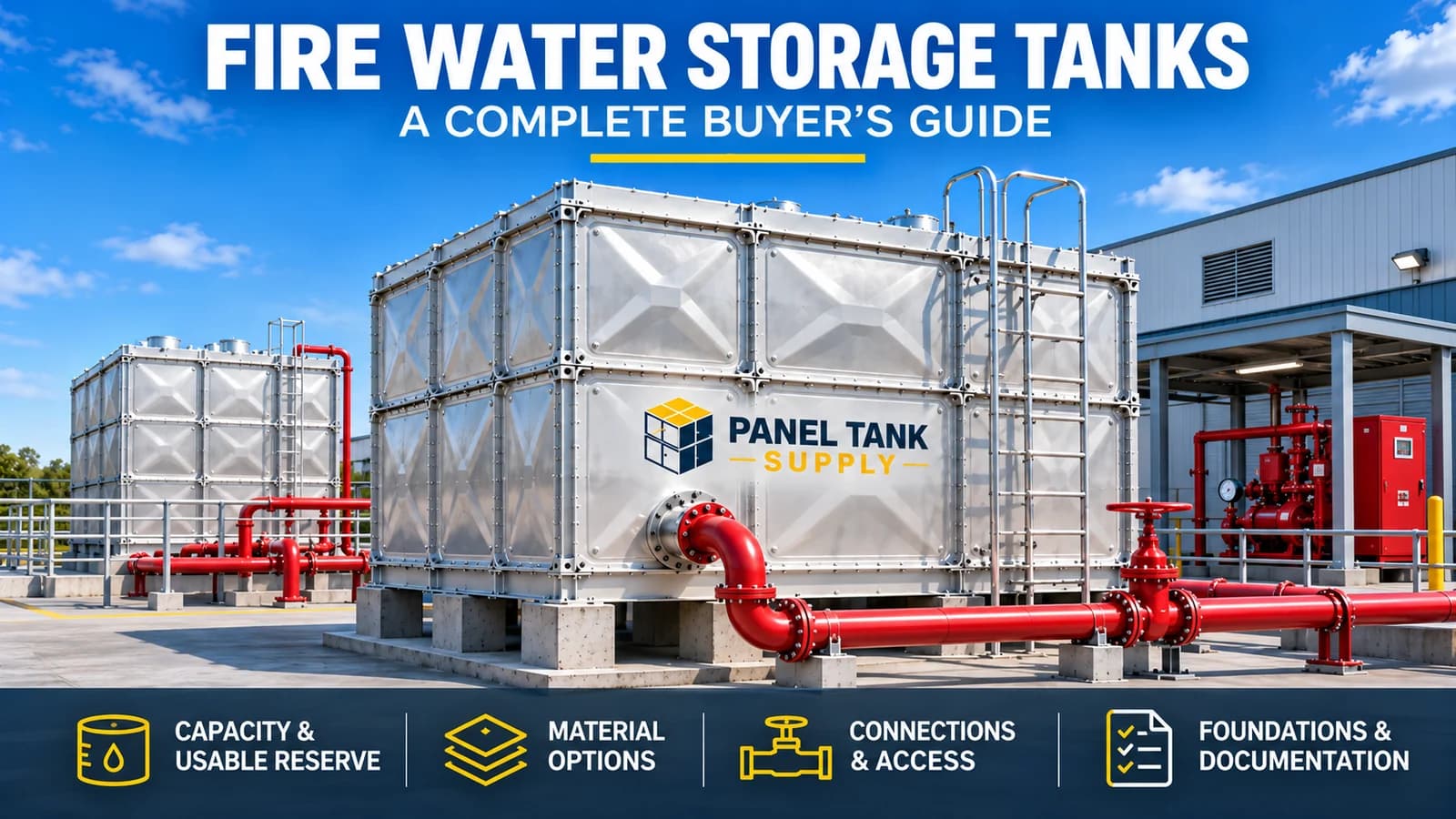
Buying a fire water storage tank involves much more than selecting a tank material and entering a gallon capacity on a purchase order.
Fire water storage is part of a life-safety system. Procurement should therefore begin with the approved fire-protection design and project requirements, which establish the required usable water reserve and the hydraulic arrangement the tank needs to support.
Once those requirements are known, the buyer can coordinate the tank material, dimensions, suction connection, fill, overflow, drain, roof, access, foundation loads, structural design and project documentation.
For US projects, NFPA 22 is an important standard addressing tanks used for private fire protection, but the project fire-protection engineer, specification and authority having jurisdiction should confirm the requirements that apply to the actual installation.
This buyer’s guide explains what contractors, engineers and procurement teams should confirm before ordering fire water storage tanks.
Start With the Approved Fire-Protection Design
The first step is not choosing GRP, galvanized steel or another tank material.
The first step is confirming what the fire-protection system requires.
The approved design should establish information such as:
- Required usable fire-water reserve
- System demand
- Required duration
- Fire pump arrangement
- Suction requirements
- Fill or refill requirements
- Applicable standards
- Project-specific requirements
The tank supplier can then develop an appropriate tank configuration around those requirements.
If the required usable volume has not yet been established, see our guide to how to size a fire water storage tank.
1. Confirm the Required Usable Fire-Water Capacity
The most important capacity figure is normally the required usable reserve, not simply a nominal tank volume.
The tank may contain water that cannot practically be used by the fire-protection system because of:
- Minimum suction level
- Outlet elevation
- Anti-vortex arrangement
- Residual water
- Overflow level
- Freeboard
- Internal geometry
A project requiring a particular usable fire-water reserve may therefore require a tank with a greater nominal or geometric capacity.
The approved fire-protection design should establish the required reserve before the final tank is ordered.
2. Do Not Buy a Tank From Capacity Alone
Two tanks with the same stated capacity may be very different projects.
One may be:
- A rectangular sectional tank inside a commercial building
- A large circular bolted tank outside an industrial facility
- A rooftop sectional tank
- A tank supporting a dedicated fire pump
- A tank in a high-wind or seismic region
The complete project requirements need to be considered alongside capacity.
3. Select the Tank Material Around the Project
Several modular tank systems may be considered for fire-water storage depending on capacity, site conditions and the project specification.
GRP / FRP Fire Water Tanks
GRP / FRP panel tanks use fiberglass-reinforced composite panels assembled into a modular rectangular tank.
They can be particularly useful where:
- Access is restricted
- Relatively lightweight components are useful
- The tank must be assembled inside a building
- Resistance to conventional steel rust is desirable
The exact product specification and project requirements should still be reviewed before selection.
Galvanized Steel Fire Water Tanks
Galvanized steel sectional tanks use pressed steel panels protected by a galvanized coating.
They are commonly considered for fire-water and general building-services storage where the selected system suits the environment and project specification.
Stainless Steel Fire Water Tanks
Stainless steel panel tanks may be relevant where stainless construction is required by the project or where the environmental conditions support that selection.
Grade selection should consider water chemistry, chloride exposure and the external environment.
Glass Fused to Steel Fire Water Tanks
Glass fused to steel tanks are commonly supplied as larger circular bolted systems.
They can be relevant where substantial external fire-water storage capacity is required.
The coating specification, structural design and project requirements should be coordinated with the application.
Fire Water Tank Materials: Quick Comparison
| Tank System | Typical Project Fit | Key Considerations |
|---|---|---|
| GRP / FRP | Commercial buildings, restricted access, plant rooms | Panel arrangement, reinforcement, project specification and access |
| Galvanized Steel | Fire water, commercial and industrial storage | Exposure environment, galvanizing, structure and support |
| Stainless Steel | Projects requiring stainless construction | Grade, chlorides, environment and cost |
| Glass Fused to Steel | Larger external fire-water storage | Capacity, coating system, site arrangement and structural design |
There is no single material that is automatically best for every fire-water project.
4. Rectangular vs Circular Fire Water Tanks
Tank geometry can influence how efficiently the required capacity fits the site.
Rectangular Sectional Tanks
Rectangular tanks can make efficient use of building and plant-room footprints.
They can also be assembled from individual components where access is too restricted for a complete fabricated vessel.
Circular Bolted Tanks
Circular bolted tanks can be particularly effective for larger outdoor storage volumes where sufficient site area is available.
The correct geometry depends on capacity, site constraints, structural requirements and the selected tank technology.
5. Confirm the Fire Pump Suction Connection
The fire pump suction arrangement is one of the most important tank interfaces.
Before manufacture, confirm:
- Suction connection diameter
- Connection type
- Required elevation
- Preferred tank wall or location
- Fire pump arrangement
- Minimum usable water level
- Anti-vortex requirements
Do not treat the suction connection as a generic outlet that can simply be added after the tank has been designed.
6. Confirm Any Anti-Vortex Requirement
The fire-protection design may require an anti-vortex arrangement at the fire pump suction.
This can affect:
- Suction elevation
- Tank connection arrangement
- Minimum usable water level
- Internal clearance
Where required, the anti-vortex arrangement should be coordinated before manufacture.
7. Confirm the Tank Fill Connection
The tank needs an appropriate fill or refill arrangement.
The buyer should provide:
- Fill connection diameter
- Connection type
- Required location
- Available incoming supply
- Control requirements
- Any project-specific refill criteria
Do not assume that available refill water automatically reduces the required stored fire reserve unless this is specifically supported by the approved fire-protection design.
8. Coordinate the Overflow
The overflow connection is part of the operating water-level arrangement.
Confirm:
- Overflow diameter
- Overflow elevation
- Connection type
- Discharge route
- Required freeboard
The surrounding drainage system should be capable of safely receiving overflow discharge.
9. Coordinate the Drain
A drain is required to support tank emptying, inspection and maintenance.
Confirm:
- Drain diameter
- Location
- Connection type
- Discharge arrangement
- Site drainage capability
Drain requirements should be coordinated early rather than added after the tank panels have been finalized.
10. Confirm the Roof System
The roof is part of the complete fire-water tank package.
Depending on the tank system, the roof arrangement may include:
- Roof panels
- Structural supports
- Access hatch
- Vent
- Level equipment
- Penetrations
- External access
Roof loads and project environmental conditions should also be considered where applicable.
11. Access Hatches, Ladders and Platforms
Inspection and maintenance access should be planned before the tank is ordered.
Depending on the project, the tank may require:
- Roof access hatch
- External ladder
- Internal ladder
- Platform
- Handrails
- Fall-protection provisions
Access equipment can affect the tank arrangement, required clearances and overall project scope.
12. Level Indication and Monitoring
The project may require visual or electronic monitoring of the stored fire-water level.
Confirm requirements for:
- Level indication
- Low-level monitoring
- High-level monitoring
- Instrumentation connections
- Control-system interfaces
Any required tank penetrations should be coordinated before manufacture.
13. Confirm Available Tank Dimensions
The required usable capacity must also fit the available project space.
Provide:
- Maximum tank length
- Maximum tank width
- Maximum tank height
- Building columns
- Walls
- Existing services
- Required maintenance clearance
Do not reduce the required fire reserve simply because the proposed plant room is too small.
The tank proportions, location or building arrangement may need to be reviewed instead.
14. Restricted-Access Fire Water Storage
Sectional construction can be particularly useful where a fire-water tank must be installed inside an existing building.
The components can be transported to the tank room separately and assembled at the final location.
Before selecting the system, confirm:
- Door dimensions
- Corridor width
- Elevator dimensions
- Elevator load capacity
- Turning areas
- Stair access
- Rooftop or crane access
- Assembly clearance
See what is a sectional water tank?
15. Foundation Requirements
A full fire-water tank creates significant loads.
The foundation or supporting structure needs to suit the actual tank configuration.
Important inputs can include:
- Operating tank weight
- Support reactions
- Tank base geometry
- Level requirements
- Anchorage
- Wind loads
- Seismic loads
- Foundation interface
The structural engineer should coordinate the supporting structure with information for the selected tank.
16. Wind and Seismic Design
Wind and seismic criteria should be established for the actual project location.
A tank specification should not assume that one design condition applies across an entire state or region.
The relevant structural design may affect:
- Tank panels or shell
- Bracing
- Roof
- Anchorage
- Foundation loads
- Attached pipework
17. Cold-Weather Requirements
Projects in cold climates may require additional measures to maintain a reliable fire-water supply.
Potential considerations can include:
- Tank insulation
- Heating where required
- Exposed connections
- Pipe freeze protection
- Roof conditions
- Access for maintenance
The project fire-protection design and specification should establish the applicable requirements.
18. NFPA 22 Should Be Treated as a Project Requirement, Not a Marketing Label
For US private fire-protection tank projects, NFPA 22 can be an important reference.
However, a buyer should not assume that simply purchasing a tank described as “NFPA 22” automatically makes the complete project compliant.
The full system still needs appropriate coordination of:
- Capacity
- Suction
- Fill
- Overflow
- Drain
- Tank construction
- Structural design
- Access
- Foundation
- Accessories
- Project-specific requirements
See our dedicated guide: NFPA 22 Water Tanks: What to Confirm Before Ordering.
19. Confirm the Authority Having Jurisdiction Requirements
The authority having jurisdiction may have project-specific requirements affecting the fire-water storage system.
These requirements should be resolved before manufacture where they influence:
- Tank size
- Connections
- Fire pump arrangement
- Inspection
- Testing
- Heating
- Structural design
- Documentation
20. What Documentation Should You Request?
Documentation requirements should be agreed before placing the order.
Depending on the project and tank system, the supply package may require:
- General arrangement drawings
- Tank dimensions
- Connection schedule
- Foundation or support information
- Material information
- Technical data
- Applicable certifications
- Installation information
- Maintenance information
- Structural design information
- Project-specific submittals
Do not assume every tank product automatically carries every certification requested by a project.
Applicable documentation should be verified for the exact proposed system.
21. Define the Supply Scope Clearly
A tank quotation should make clear what the supplier is actually providing.
Possible scope items can include:
- Tank panels
- Structural components
- Roof
- Bracing
- Bolts and seals
- Connections
- Access equipment
- Level equipment
- Technical drawings
- Installation information
- Freight
The project team should also establish who is responsible for:
- Foundation works
- Tank assembly
- Crane or lifting equipment
- Connected piping
- Electrical work
- Fire pump installation
- Commissioning
- Testing
Comparing quotations without aligning the scope can produce misleading price comparisons.
22. Freight and Delivery
Modular tanks can be shipped as components rather than one large completed vessel.
For freight planning, provide:
- Project ZIP code and state
- Site access information
- Delivery restrictions
- Unloading arrangements
- Storage requirements
- Required delivery date
Remote or congested sites may require additional logistics planning.
23. What Information Should Be Included in an RFQ?
A useful fire-water tank RFQ should include as much of the following as possible:
- Required usable fire-water reserve
- Fire-protection drawings
- Project ZIP code and state
- Maximum available dimensions
- Preferred tank system if specified
- Suction connection size and elevation
- Fill connection size
- Overflow size
- Drain size
- Other required connections
- Operating water levels where known
- Anti-vortex requirements
- Access hatch requirements
- Ladders and platforms
- Level monitoring requirements
- Indoor or outdoor location
- Structural design criteria
- Heating or insulation requirements
- Applicable standards
- Required certifications
- Project specifications
- Required delivery date
24. Common Fire Water Tank Procurement Mistakes
Ordering Before the Fire Design Is Finalized
Capacity and hydraulic requirements should be sufficiently developed before final manufacture.
Buying From Nominal Gallons Alone
Confirm that the tank provides the required usable reserve.
Leaving Suction Details Until Late
Fire pump suction and anti-vortex requirements can affect the tank arrangement.
Ignoring the Foundation
Tank geometry and support loads need to be coordinated with the project structure.
Comparing Unequal Supplier Scopes
Make sure quotations include comparable connections, accessories, documentation and freight.
Assuming Every Tank Has the Same Certification
Verify documentation for the exact tank system proposed.
Forgetting Site Access
A tank that fits the final location still needs an installation and delivery route.
25. How to Compare Fire Water Tank Quotations
Do not compare only the bottom-line price.
Check whether each quotation is based on the same:
- Usable capacity
- Tank dimensions
- Material specification
- Structural criteria
- Suction connection
- Fill connection
- Overflow
- Drain
- Roof
- Ladders and platforms
- Level monitoring
- Documentation
- Freight scope
A cheaper quotation with a reduced scope may not be the lower-cost project solution.
Fire Water Storage Tanks: Final Buyer Checklist
Before placing an order, confirm:
- The approved usable fire-water reserve
- The applicable fire-protection requirements
- The selected tank material
- The final tank dimensions
- The fire pump suction arrangement
- Any anti-vortex requirement
- The fill connection
- The overflow
- The drain
- Access and maintenance equipment
- Level monitoring
- The supporting foundation
- Wind and seismic criteria
- Cold-weather requirements where applicable
- Required project documentation
- Applicable certifications
- AHJ requirements
- Freight and delivery scope
- Installation responsibility
- Required delivery date
A fire-water storage tank should be treated as an engineered component of the complete fire-protection system rather than simply as a vessel purchased by gallon capacity.
Need a Fire Water Storage Tank for Your Project?
Panel Tank Supply can review your approved fire-water requirements and help identify suitable modular tank systems for quotation.
Send the required usable reserve, project ZIP code and state, available tank dimensions, suction and fill requirements, overflow, drain, structural criteria and any available fire-protection drawings or specifications.
Request Fire Water Tank Pricing →
Frequently Asked Questions
What Is a Fire Water Storage Tank?
A fire water storage tank provides stored water for a private fire-protection system where the project requires a dedicated reserve. The required usable capacity and hydraulic arrangement should come from the approved fire-protection design.
What Information Is Needed Before Ordering a Fire Water Tank?
At minimum, confirm the required usable reserve, project location, available dimensions, fire pump suction requirements, fill, overflow, drain, structural criteria and applicable fire-protection specifications.
What Tank Materials Can Be Used for Fire Water?
Depending on the project, modular systems can include GRP / FRP, galvanized steel, stainless steel and larger bolted glass fused to steel tanks. Final selection depends on capacity, environment, access and specification.
What Is NFPA 22?
NFPA 22 is the US standard addressing water tanks for private fire protection. The project designer and authority having jurisdiction should confirm the requirements and edition applicable to the installation.
Is Nominal Tank Capacity the Same as Usable Fire Reserve?
Not necessarily. Suction level, residual water, freeboard and overflow arrangement can mean the usable fire reserve is less than the tank’s total geometric volume.
Does a Fire Water Tank Need an Anti-Vortex Device?
The fire-protection design should establish whether an anti-vortex arrangement is required and how it should be coordinated with the suction connection and minimum usable water level.
Can a Fire Water Tank Be Installed Inside a Building?
Yes, suitable sectional systems can be assembled inside buildings where components can reach the tank location and sufficient assembly and maintenance clearance is available.
Does the Tank Supplier Design the Fire-Water Requirement?
The required fire-water demand and reserve should generally come from the qualified fire-protection or hydraulic design. The tank supplier then configures a suitable tank around that requirement.
What Should I Compare Between Fire Tank Quotations?
Compare usable capacity, material, structural criteria, suction and fill arrangements, overflow, drain, roof, access equipment, documentation, freight and the complete supplier scope rather than only headline price.